Sorrows, sorrows, prayers has transcended its television origins to become a cultural shorthand for a very modern dilemma: how to respond to overwhelming emotional news. This deceptively simple phrase, popularized by the character Queen Charlotte in the Netflix series Bridgerton, has become a viral sensation and a powerful tool for emotional boundary-setting. What might sound like a cold or dismissive response is actually a masterclass in self-preservation in an age of constant connectivity and information overload. This comprehensive guide will explore everything from the origins of the phrase to its profound psychological underpinnings, providing you with a deep understanding of why these three words have captured the collective imagination and how they can be applied responsibly in your own life to protect your mental wellbeing while maintaining compassion for others.
The Origins: Queen Charlotte’s Icy Comfort 👑

- A Royal Dismissal: The phrase was introduced to popular culture through the character Queen Charlotte in the Netflix series Queen Charlotte: A Bridgerton Story.
- Fictional Context: She used the glacial, detached phrase “sorrows, sorrows, prayers” to console loved ones in emotional distress, such as Prince George grieving his daughter or Lady Danbury after the loss of her husband .
- Comedic Truth-Telling: Actress Golda Rosheuvel, who plays Queen Charlotte, noted that the phrase’s comedy comes from its truth, reflecting the “complex relationship that she has with her children” .
- Viral Momentum: The phrase sparked immediate recognition on platforms like TikTok, where users shared their own experiences of not knowing how to react in emotionally charged situations.
- Cultural Translation: It moved from a fictional royal put-down to a genuine tool for everyday people navigating complex social interactions.
- Digital Age Relevance: The phrase found its footing in an era of “trauma dumping” and digital oversharing, providing a humorous yet clear way to establish conversational limits.
- Beyond the Screen: While its origin is fictional, its application is intensely real for millions who have adopted it.
- A Modern Mantra: It has been transformed into a mantra for those who feel emotionally drained by the constant demands of others’ problems.
- Symbolic Distance: The phrase creates symbolic distance without complete emotional abandonment, representing a middle ground between over-involvement and utter indifference.
- Linguistic Armor: In a therapeutic culture, it provides linguistic armor for those who feel pressured to perform emotional labor they cannot afford to give.
Deconstructing the Meaning: More Than Just a Meme 🧩
- Emotional Triage: The phrase acts as a form of emotional triage, acknowledging a problem while signaling your inability to engage deeply with it at that moment.
- Boundary Setting: It’s a prime example of learning how not to absorb someone else’s sadness or anxiety when they share it with you .
- Compassionate Detachment: The repetition of “sorrows” serves to acknowledge the pain, while “prayers” offers a token gesture of support without deep engagement.
- Anti-Trauma-Dumping Tool: It has been widely adopted as a response to “trauma dumping” – the act of unloading traumatic experiences on others without consent or warning.
- Emotional Capacity Awareness: The phrase implicitly communicates “I hear you, but I am at capacity for handling heavy emotional material right now.”
- Social Script Short-circuit: It provides an alternative to the expected, emotionally intensive responses that people often feel obligated to provide.
- Permission-Giving: For many, using the phrase (even mentally) gives permission to not solve, fix, or fully immerse themselves in every problem they encounter.
- Layered Interpretation: On the surface, it appears dismissive; at a deeper level, it represents sophisticated emotional intelligence about one’s own limits.
- Cultural Commentary: The phrase comments on the modern expectation of constant emotional availability and pushes back against it.
- Psychological Shield: It functions as a psychological shield against compassion fatigue, particularly for empaths and highly sensitive people.
The Psychology Behind the Phrase: Why It Resonates 🧠
- Boundary Preservation: Therapists confirm that “it is perfectly healthy to have boundaries in place when it comes to taking on other people’s emotions” .
- Preventing Internalization: Without boundaries, people can “internalise other’s emotions to the point of feeling physically drained and depleted” .
- Relationship Strengthening: Contrary to intuition, boundaries “are, in fact, likely to strengthen your relationship with others as there is less of a chance of you feeling like a ‘doormat'” .
- Emotional Differentiation: The phrase helps differentiate between compassion (feeling for someone) and absorption (taking on their feelings as your own).
- Cognitive Load Management: In an information-saturated world, it provides a cognitive shortcut for managing emotional demands alongside other responsibilities.
- Empathic Distress Prevention: It serves as a barrier against empathic distress – the feeling of being overwhelmed by another’s suffering to the point of paralysis.
- Autonomy Protection: The phrase protects personal autonomy by establishing that one’s emotional resources are finite and require careful allocation.
- Self-Preservation Instinct: It resonates because it aligns with our biological instinct for self-preservation when faced with potential emotional overwhelm.
- Modern Coping Mechanism: For digital natives constantly exposed to global and personal tragedies alike, it provides a necessary coping mechanism.
- Psychological Validation: Using the phrase validates the very real experience of emotional exhaustion in a way that traditional responses do not.
When to Use “Sorrows, Sorrows, Prayers” IRL 🗓️
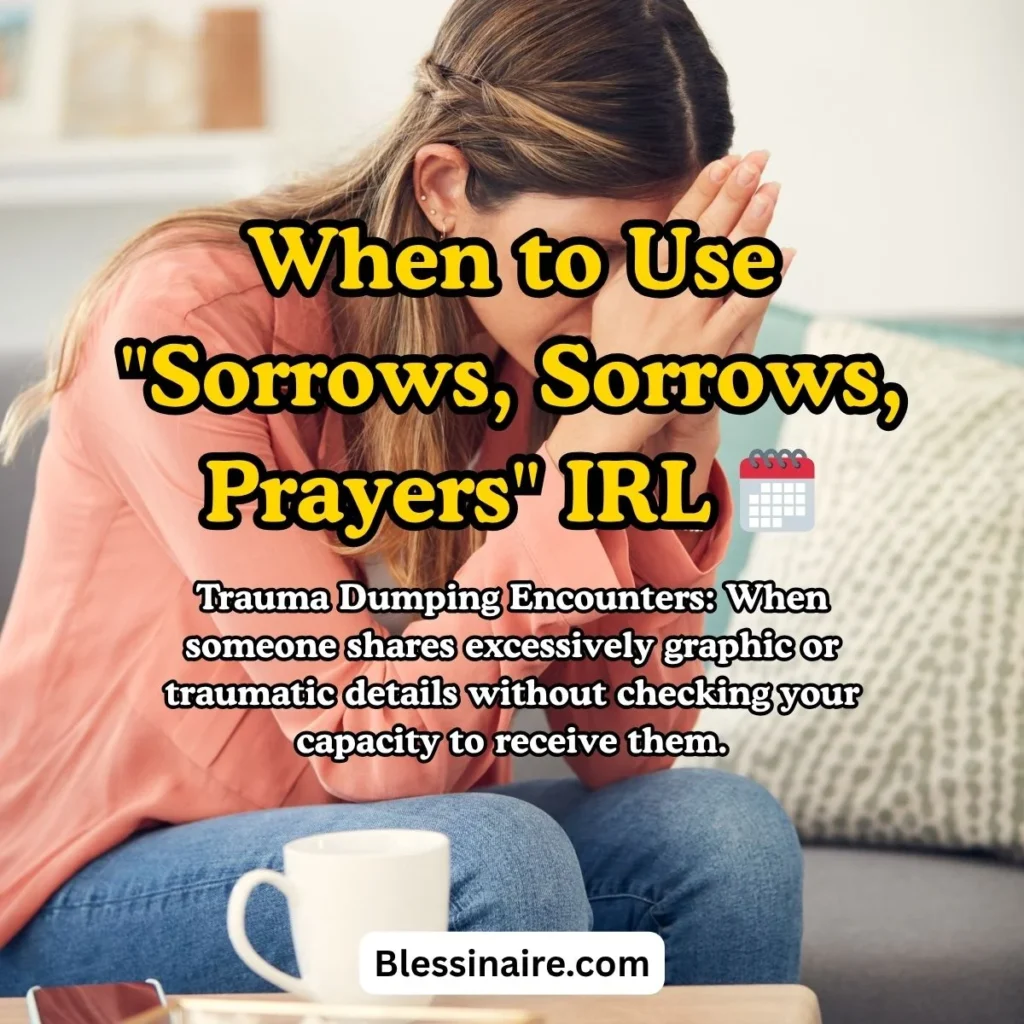
- Trauma Dumping Encounters: When someone shares excessively graphic or traumatic details without checking your capacity to receive them.
- Emotional Capacity Limits: When you’re personally depleted, stressed, or dealing with your own significant challenges and lack emotional bandwidth.
- Manipulative Conversations: When you detect that someone is using their distress to manipulate you into compliance or special treatment.
- Recurrent Patterns: With individuals who consistently return with the same problems but refuse to implement solutions or seek professional help.
- Workplace Boundaries: In professional settings where maintaining appropriate boundaries is necessary for career preservation and mental health.
- Digital Overload: As a mental response to absorbing endless streams of bad news on social media or news platforms.
- Group Dynamics: In group chats or social media comments where someone derails the conversation with excessively personal trauma.
- Energy Protection: For highly sensitive people and empaths who naturally absorb emotional energy from their environment.
- Preliminary Filtering: As an internal checkpoint before deciding whether you have the resources to engage more deeply with someone’s problem.
- Preventing Resentment: To avoid building resentment toward people in your life who regularly demand emotional labor without reciprocity.
Healthy Boundary Setting vs. Emotional Avoidance ⚖️
- Intent Difference: Healthy boundaries are about self-care; emotional avoidance is about fear of intimacy or uncomfortable feelings.
- Consistency Pattern: Boundaries are consistently applied based on capacity; avoidance is situational based on discomfort.
- Relationship Impact: Boundaries strengthen relationships over time; avoidance erodes trust and connection.
- Self-Awareness Level: Boundary-setters can articulate their limits; avoiders often cannot explain their withdrawal.
- Compassion Presence: Boundaries can be set with compassion; avoidance typically lacks empathetic engagement.
- Reciprocity Factor: Those with healthy boundaries can receive support when needed; avoiders often struggle to be there for others.
- Communication Style: Boundary-setters communicate limits clearly; avoiders use distraction, minimization, or withdrawal.
- Therapist Perspective: Victoria Jeffries emphasizes that while boundaries are essential, it’s “important to be mindful that you are not detaching from the other person’s emotions to the point of being completely cold and uncaring” .
- Balance Finding: The healthiest approach finds middle ground between complete emotional enmeshment and total emotional abandonment.
- Context Matters: Appropriate boundaries vary by relationship type, cultural context, and the specific situation at hand.
Alternative Responses for Different Situations 💬
- The Compassionate Redirect: “I can hear you’re struggling, and I wish I had the capacity to give this the attention it deserves right now.”
- The Resource Provider: “That sounds incredibly difficult. Have you considered speaking with a therapist who would be better equipped to help?”
- The Time-Boundaried Offer: “I can’t talk deeply right now, but I’d be happy to schedule a call this weekend when I can really focus on what you’re saying.”
- The Activity-Based Support: “I’m not great with heavy emotional conversations, but I’d love to take your mind off things with a walk/movie/coffee.”
- The Validating Brief Response: “That sounds incredibly challenging, and I appreciate you sharing it with me. I’m sending you strength.”
- The Question-Based Approach: “Are you looking for advice, or do you just need me to listen right now?” (This helps clarify expectations).
- The Graduated Disclosure Response: “I have some capacity, but would you mind giving me the abbreviated version for now?”
- The Referral with Self-Protection: “I’m not qualified to help with something this serious, but I can help you find someone who is.”
- The Future-Focused Reply: “I want to be present for this conversation when I can give it my full attention. Can we circle back tomorrow?”
- The Honest Capacity Statement: “I’m dealing with some personal challenges myself right now and don’t have the emotional resources to be there for you fully.”
The Social Media Impact: From TV to TikTok 📱
- Viral Transformation: The phrase exploded on TikTok, with users creating videos depicting situations where “sorrows, sorrows, prayers” was the only appropriate response.
- Cultural Shortcut: It became a cultural shortcut for expressing emotional overwhelm in response to both serious and trivial problems.
- Memetic Evolution: The phrase evolved beyond its original context to apply to everything from minor inconveniences to genuine tragedies.
- Community Building: Using the phrase creates in-group belonging among those who understand its origin and significance.
- Humor as Coping: The humorous application of the phrase to everyday frustrations provides comic relief in a high-stress world.
- Normalization of Boundaries: Its popularity has helped normalize the concept of emotional boundaries for a generation that struggles with them.
- Digital Emotional Labor: The phrase acknowledges the unique challenge of digital emotional labor, where friends and strangers alike expect immediate, thoughtful responses to trauma.
- Generational Divide: Its usage often splits along generational lines, with older generations sometimes perceiving it as cold and younger generations seeing it as necessary.
- Adaptive Function: On platforms where users are exposed to countless tragedies and struggles, it serves an adaptive function for psychological survival.
- Linguistic Innovation: It represents how digital culture creates new linguistic tools for navigating modern social and emotional challenges.
Professional Perspectives: What Therapists Think 🛋️
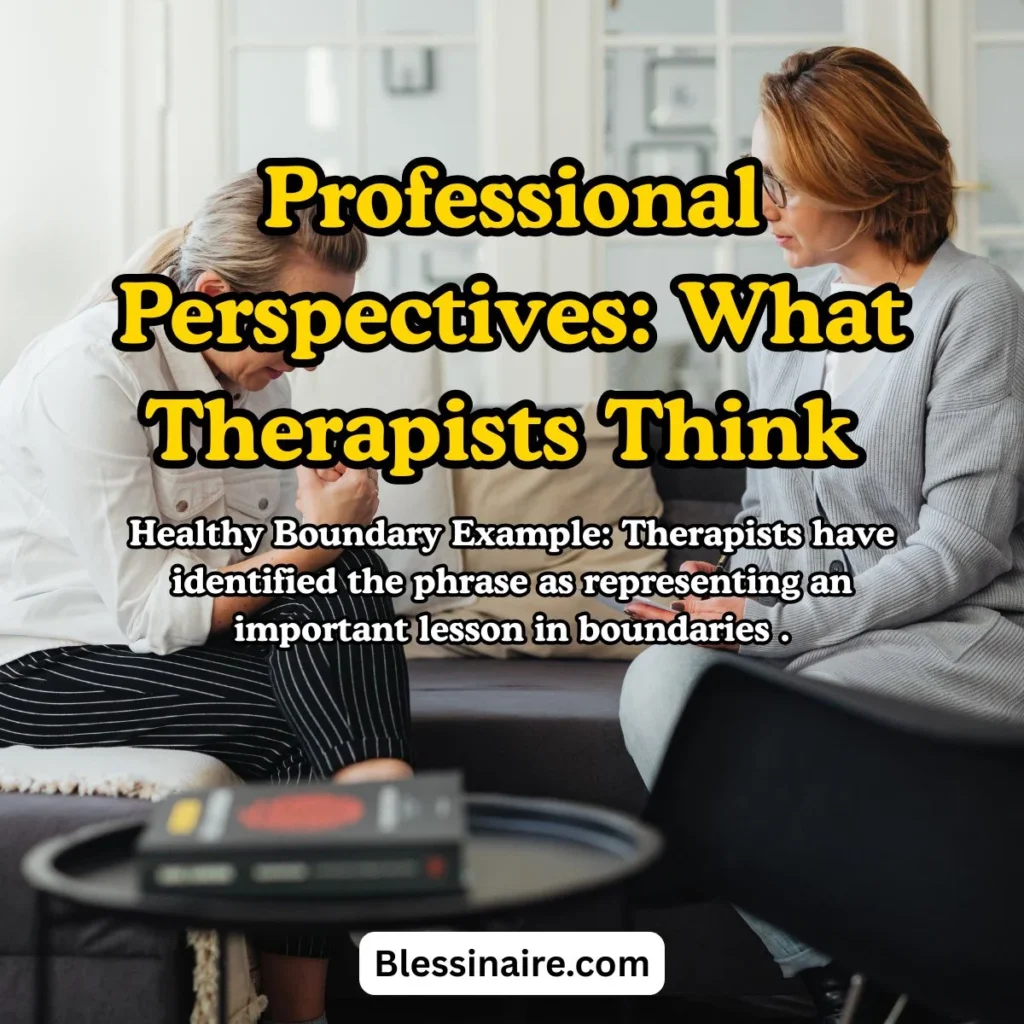
- Healthy Boundary Example: Therapists have identified the phrase as representing an important lesson in boundaries .
- Preventing Drainage: “Absorbing other’s negative emotions can be detrimental to your own mental health,” leading to feeling “physically drained and depleted” .
- Essential Limits: “Boundaries are essential here,” says therapist Victoria Jeffries, “as you are signalling to others what is within your remit” .
- Compassion Balance: Professionals emphasize the importance of balancing boundaries with compassion, avoiding being “completely cold and uncaring” .
- Practical Strategies: Therapists suggest practical approaches like being “aware of how much you can handle” and setting time limits for difficult conversations .
- Alternative Activities: Suggesting “productive activities” instead of ruminating on problems can be “more effective” for both parties .
- Professional Referral: “Gently pointing out that, while you are there for them, you may not be the best person to help them in the long run” is often appropriate .
- Self-Awareness Development: The phrase encourages crucial self-awareness about “what are your own feelings… and what aren’t” when listening to others’ problems .
- Emotional Responsibility: Therapists note the importance of recognizing that others’ sadness “is not your sadness and you do not need to take these feelings on” .
- Clinical Utility: Some therapists acknowledge using the concept (though not necessarily the phrase) with clients who struggle with boundaries and enmeshment.
Cultural Context: A Phrase for Our Times 🌍
- Post-Therapeutic Society: The phrase emerges from a culture saturated with therapeutic concepts but struggling with their practical application.
- Information Overload: It responds to the unprecedented access we have to the suffering of both close contacts and complete strangers worldwide.
- Burnout Generation: It particularly resonates with millennials and Gen Z, who report higher rates of burnout and mental health challenges.
- Digital Communication Challenges: The phrase addresses the unique difficulties of setting boundaries in always-connected digital environments.
- Changing Social Contracts: It reflects evolving social contracts about what we owe each other emotionally and how much vulnerability is appropriate.
- Global Pandemic Influence: The COVID-19 pandemic heightened collective anxiety while limiting support systems, making boundary-setting more crucial than ever.
- Mental Health Awareness: As mental health awareness increases, so does recognition of the toll that constant emotional support can take on individuals.
- Generational Communication Styles: It represents a generational shift toward more direct (if humorously veiled) communication about limits and capacity.
- Economic Pressures: Financial precarity and economic pressures leave less emotional bandwidth for dealing with others’ problems for many people.
- Cultural Translation: The phrase has been adopted across cultures, though its interpretation and appropriateness vary based on cultural norms around emotional expression.
Using the Concept Responsibly: Avoiding Harm 🚧
- Context Sensitivity: Genuine crises require engaged responses, not glib phrases – discernment is crucial.
- Relationship Consideration: The appropriateness varies dramatically depending on your relationship with the person and their usual communication patterns.
- Cultural Appropriateness: In cultures where direct emotional expression is valued, the phrase might cause more offense than it’s worth.
- Power Dynamics: Those in positions of power (managers, parents, mentors) should be extremely cautious about using such distancing language.
- Crisis Recognition: Learn to distinguish between everyday distress and genuine crisis situations requiring immediate, engaged support.
- Internal vs. External Use: The phrase can be a helpful mental reminder of boundaries even when you choose to respond more substantively.
- Avoiding Weaponization: Never use the concept to dismiss the legitimate pain of marginalized groups or to avoid important social conversations.
- Balance Seeking: If you find yourself constantly using this mindset, it may indicate isolation or emotional withdrawal that warrants examination.
- Reciprocity Evaluation: Ensure you’re not consistently receiving support from others while offering only minimal responses in return.
- Growth Opportunity: Periodically examine whether your boundaries have become rigid walls preventing meaningful connection and growth.
The Future of the Phrase: Lasting Concept or Passing Fad? 🔮
- Concept Survival: While the specific phrase may fade, the underlying concept of respectful emotional boundary-setting is likely permanent.
- Linguistic Evolution: The phrase will likely evolve into new forms as cultural conversations around mental health continue to develop.
- Mainstream Integration: Elements of the concept are being integrated into mainstream therapy, coaching, and leadership training.
- Generational Legacy: As digital natives age and assume more leadership roles, these boundary-setting concepts may become organizational norms.
- Backlash Potential: There is potential for cultural backlash against what some perceive as excessive self-protection and lack of community responsibility.
- Academic Interest: The phrase and phenomenon may attract academic research into digital communication, mental health, and linguistic trends.
- Commercial Co-option: Brands will likely co-opt the concept for marketing, though this may dilute its original meaning and power.
- Therapeutic Application: Mental health professionals may develop more structured approaches based on the intuitive wisdom the phrase represents.
- Global Spread: As English-language internet culture spreads globally, the phrase and its equivalents will continue to cross cultural boundaries.
- Cultural Metric: Its longevity will serve as a metric for how permanently our cultural approach to emotional labor and boundaries is shifting.
Frequently Asked Questions ❓
- What does “sorrows, sorrows, prayers” mean?
It’s a phrase acknowledging someone’s distress while establishing emotional boundaries and signaling limited capacity to engage deeply with the problem. - Where did “sorrows, sorrows, prayers” originate?
The phrase comes from the character Queen Charlotte in the Netflix series Queen Charlotte: A Bridgerton Story, where she used it as a detached form of sympathy. - Is using “sorrows, sorrows, prayers” rude?
It can be perceived as rude if used literally in serious situations, but as a concept, it represents important principles of emotional boundary-setting. - How can I set boundaries without being dismissive?
Offer alternative support forms, be honest about your capacity, suggest professional resources, and make it clear your limitation is about your capacity, not their worth. - Why has this phrase become so popular?
It resonates because it addresses modern challenges of emotional overload, trauma dumping, and the constant connectivity of digital life. - Do therapists approve of this approach?
Therapists endorse the boundary-setting principles behind the phrase while emphasizing the importance of balancing boundaries with compassion. - When should I NOT use this approach?
Avoid it in genuine crises, with vulnerable people who depend on you, in professional caregiving contexts, and when you have the capacity to offer meaningful support. - How can I respond to trauma dumping without being cold?
Acknowledge their pain, express your capacity limits clearly, offer alternative forms of support, and suggest more appropriate resources if needed. - What’s the difference between boundaries and avoidance?
Boundaries are conscious choices made from self-awareness to preserve wellbeing; avoidance is fear-based withdrawal from necessary intimacy or responsibility. - Can this phrase damage relationships?
Used insensitively or excessively, any boundary-setting approach can damage relationships, which is why context, relationship nature, and delivery matter tremendously.
Conclusion: Finding Balance in an Emotionally Demanding World
The cultural journey of sorrows, sorrows, prayers from fictional royal dismissal to psychological tool reveals much about our contemporary relationship with emotional labor. This viral phrase represents more than just internet humor; it encapsulates a crucial modern survival skill. As we navigate increasingly complex social landscapes both online and off, the principles behind these words – self-awareness, honest boundary-setting, and intentional compassion – provide a framework for sustainable relationships in demanding times. The enduring power of sorrows, sorrows, prayers lies not in its specific wording, but in the vital conversation it has sparked about how we care for both others and ourselves in a world of limitless demands and finite emotional resources.

I write to share spiritual blessings that inspire gratitude, strengthen faith, and bring peace to the heart. My goal is to help others see each day as a sacred gift filled with love and light.