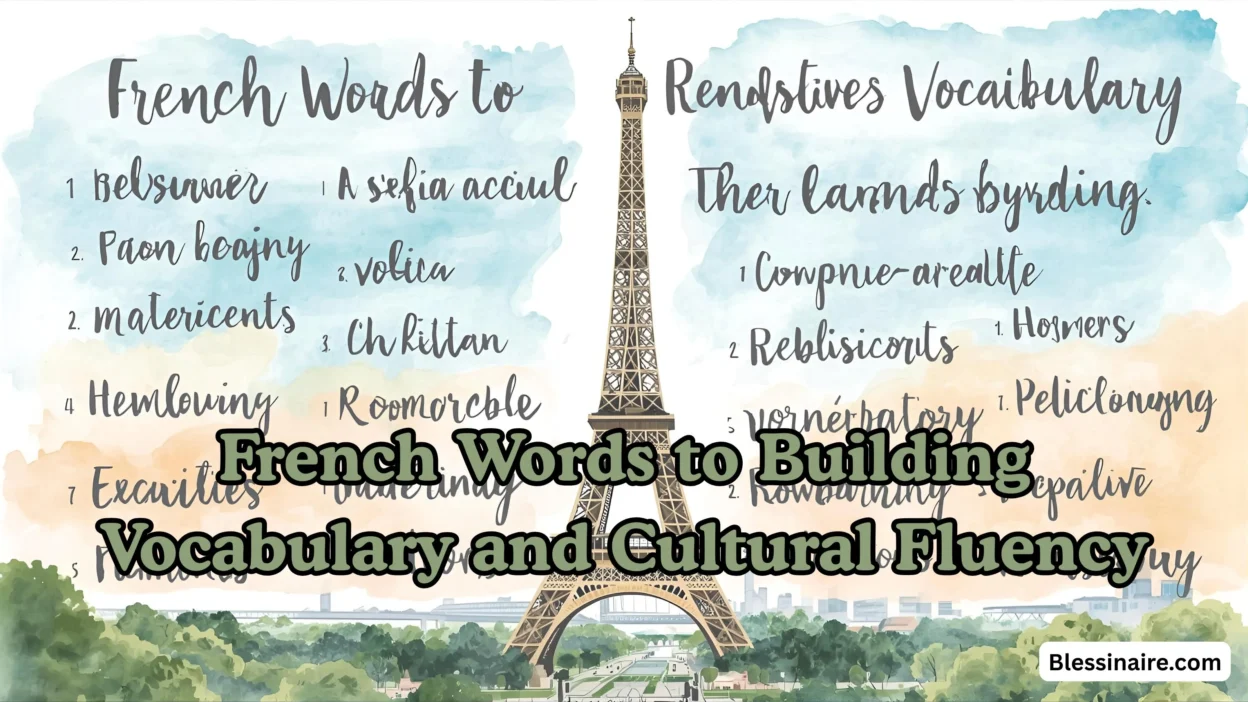
French words represent more than just vocabulary—they’re gateways to a rich cultural tapestry that spans continents and centuries. As the official language of 29 countries with over 300 million speakers worldwide, French offers exceptional value for travelers, professionals, and language enthusiasts alike. Learning essential French vocabulary does more than enable communication; it provides insight into the French psyche, cultural values, and unique ways of expressing ideas that differ significantly from English. This comprehensive guide explores foundational French terms, contemporary expressions, and practical learning strategies to build your confidence in understanding and using French vocabulary effectively. Whether you’re preparing for travel, advancing your career, or pursuing personal enrichment, mastering these French words and phrases will transform your language skills and cultural appreciation.
Foundational French Words: Essential Vocabulary for Beginners 🎯
Building a strong foundation in French begins with mastering everyday vocabulary that enables basic communication. These essential French words form the building blocks for more complex conversations and understanding.
- Greetings and Basic Politeness: Start with “bonjour” (hello/good day), “au revoir” (goodbye), “s’il vous plaît” (please, formal), “merci” (thank you), and “excusez-moi” (excuse me).
- Common Pronouns and People: Master “je” (I), “tu” (you, informal), “vous” (you, formal/plural), “il/elle” (they), “homme” (man), “femme” (woman), “ami” (friend).
- Question Words: Essential for gathering information: “qui” (who), “quoi” (what), “où” (where), “quand” (when), “pourquoi” (why), “comment” (how).
- Basic Verbs: Action words like “être” (to be), “avoir” (to have), “aller” (to go), “faire” (to do/make), “pouvoir” (to be able to), “vouloir” (to want).
- Common Nouns: Everyday objects: “maison” (house), “voiture” (car), “nourriture” (food), “eau” (water), “temps” (time/weather), “livre” (book).
- Numbers 1-20: “un, deux, trois, quatre, cinq, six, sept, huit, neuf, dix, onze, douze, treize, quatorze, quinze, seize, dix-sept, dix-huit, dix-neuf, vingt.”
- Colors: “rouge” (red), “bleu” (blue), “vert” (green), “jaune” (yellow), “noir” (black), “blanc” (white), “rose” (pink).
- Days of the Week: “lundi, mardi, mercredi, jeudi, vendredi, samedi, dimanche.”
- Directions and Locations: “ici” (here), “là” (there), “devant” (in front), “derrière” (behind), “gauche” (left), “droite” (right).
- Food and Dining: “pain” (bread), “fromage” (cheese), “vin” (wine), “café” (coffee), “restaurant” (restaurant), “addition” (bill).
French Grammar Essentials: Key Rules for Proper Usage 📝
Understanding basic French grammar rules is essential for using French words correctly in context. These grammatical structures differ significantly from English and require practice to master.
- Gendered Nouns: Every French noun has a gender—masculine or feminine—which affects associated articles and adjectives. For example, “le livre” (the book, masculine) versus “la table” (the table, feminine).
- Definite and Indefinite Articles: These change based on gender and number: “le” (masculine), “la” (feminine), “les” (plural), “un” (masculine), “une” (feminine).
- Verb Conjugation: French verbs change endings based on subject, tense, and mood. Regular -er verbs like “parler” (to speak) follow patterns: “je parle, tu parles, il/elle parle, nous parlons, vous parlez, ils/elles parlent.”
- Adjective Agreement: Adjectives must match the gender and number of nouns they describe. “Petit” (small, masculine) becomes “petite” for feminine nouns, and “petits/petites” for plural.
- Formal vs. Informal Address: The choice between “tu” (informal) and “vous” (formal) depends on your relationship with the person. When in doubt, use “vous” to show respect.
- Sentence Structure: French typically follows Subject-Verb-Object order, but adjectives often come after nouns: “une voiture rouge” (a red car).
- Negation: To make a sentence negative, place “ne…pas” around the verb: “Je ne parle pas français” (I don’t speak French).
- Contractions: French uses mandatory contractions like “au” (“à + le”) and “du” (“de + le”), unlike optional English contractions.
- Pronoun Placement: Object pronouns precede the verb: “Je le vois” (I see him/it).
- Question Formation: Questions can be formed through inversion (“Parlez-vous français?”), adding “est-ce que” (“Est-ce que vous parlez français?”), or rising intonation (“Vous parlez français?”).
French Pronunciation Guide: Mastering the Music of French 🎵
Proper pronunciation is key to being understood in French and appreciating the language’s musical quality. These guidelines will help you sound more authentic when speaking French words.
- Nasal Vowels: French has distinctive nasal sounds like “on” (as in “bon”), “an” (as in “français”), “in” (as in “vin”), and “un” (as in “un”).
- The French “R”: This guttural sound, made in the back of the throat, differs significantly from the English “R.” Practice with words like “rouge,” “frère,” and “Paris.”
- Silent Letters: French often has silent consonants at word endings. The final “s” in “vous,” “t” in “et,” and “d” in “grand” are typically silent.
- Liaison and Elision: Liaison occurs when a normally silent consonant is pronounced before a vowel: “vous_êtes” (you are). Elision drops vowels before similar sounds: “l’école” instead of “la école.”
- Accent Marks: French uses four accent marks that affect pronunciation: acute (“é” – ehh), grave (“è” – eh), circumflex (“ê” – eh), and diaeresis (“ë” – indicates separate pronunciation).
- Letter “U”: The French “u” (as in “tu”) has no English equivalent—form it by saying “ee” while rounding your lips.
- Double Consonants: Generally, double consonants are pronounced as single sounds: “histoire” (history), “addition” (bill).
- Stress Patterns: French has more even stress across words and sentences compared to English’s varied stress patterns.
- Common Pronunciation Challenges: English speakers often struggle with differentiating “u” (“tu”) and “ou” (“tout”), and nasal versus oral vowels.
- Practice Techniques: Listen and repeat after native speakers, use pronunciation guides, and record yourself to identify areas for improvement.
Contemporary French Vocabulary: Modern Words and Recent Additions 🆕
The French language continues to evolve, incorporating new terms that reflect technological advancements, social changes, and cultural trends. These contemporary French words demonstrate the living nature of the language.
- Digital and Technology Terms: “cyberterrorisme” (cyberterrorism), “visibiliser” (to raise your online profile), “désanonymiser” (to de-anonymize), and “webtoon” (online cartoon).
- Environmental Vocabulary: Recent additions include “mégabassine” (huge farming water reservoir), “agrotoxique” (characteristic of damaging farming substances), and “écogeste” (eco-friendly action).
- Social Movements and Concepts: “masculinisme” (men’s rights movement), “platisme” (flat-Earth belief), and “empouvoirement” (empowerment).
- Modern Slang (Verlan): French backward slang includes “chanmé” (awesome, from “méchant”), “chelou” (sketchy, from “louche”), and “teuf” (party, from “fête”).
- English Loanwords: Despite resistance, terms like “fast-fashion,” “skatepark,” “batch-cooking,” and “ultra-trail” have entered French dictionaries.
- Professional World: “trottinettiste” (electric scooter user), “spéléonaute” (cave explorer), and “champignonneur” (mushroom gatherer) reflect evolving professions and activities.
- Québecois Innovations: The Québecois created “divulgâcher” as an elegant alternative to “spoiler” (to reveal plot details).
- Internet and Social Media Verbs: “liker” (to like online content), “googliser” (to google), though these face resistance from language purists.
- African French Contributions: Words like “liboké” (food wrapped in banana leaves) and “cadeauter” (to gift) enrich the French lexicon.
- Gender-Neutral Language: While “iel” (gender-neutral pronoun) hasn’t entered mainstream dictionaries yet, it reflects ongoing linguistic evolution.
Time-Related Vocabulary: Expressing Time and Duration in French ⏰
Mastering time-related French words is crucial for scheduling, making plans, and discussing past, present, and future events. This vocabulary helps you navigate daily conversations with confidence.
- Basic Time Units: “une seconde” (second), “une minute” (minute), “une heure” (hour), “un jour” (day), “une semaine” (week), “un mois” (month), “un an” (year).
- Times of Day: “le matin” (morning), “l’après-midi” (afternoon), “le soir” (evening), “la nuit” (night), “midi” (noon), “minuit” (midnight).
- Relative Time References: “hier” (yesterday), “aujourd’hui” (today), “demain” (tomorrow), “avant-hier” (day before yesterday), “après-demain” (day after tomorrow).
- Frequency Adverbs: “toujours” (always), “souvent” (often), “parfois” (sometimes), “rarement” (rarely), “jamais” (never).
- Time-Based Adjectives: “quotidien(ne)” (daily), “hebdomadaire” (weekly), “mensuel(le)” (monthly), “annuel(le)” (yearly), “biquotidien(ne)” (twice daily).
- Prepositions of Time: “à” (at, for specific times), “en” (in, for months/seasons/years), “dans” (in, for future time), “depuis” (since/for), “pendant” (during).
- Duration Phrases: “une fois par semaine” (once a week), “tous les jours” (every day), “tous les deux jours” (every other day), “tous les trois mois” (every three months).
- Historical Periods: “une décennie” (decade), “un siècle” (century), “un millénaire” (millennium), “l’époque” (era/period).
- Sequencing Words: “d’abord” (first), “puis” (then), “ensuite” (next), “enfin” (finally), “finalement” (ultimately).
- Punctuality Expressions: “à l’heure” (on time), “en avance” (early), “en retard” (late), “à temps” (in time).
French for Travel: Practical Vocabulary for Tourists ✈️
When visiting French-speaking destinations, these practical French words will enhance your travel experience, help you navigate unfamiliar places, and connect with locals more meaningfully.
- Transportation Terms: “billet” (ticket), “gare” (station), “aéroport” (airport), “quai” (platform), “arrêt” (stop), “location de voiture” (car rental).
- Accommodation Vocabulary: “hôtel” (hotel), “chambre” (room), “clé” (key), “ascenseur” (elevator), “petit déjeuner” (breakfast), “réception” (front desk).
- Dining and Food Terms: “carte” (menu), “apéritif” (pre-dinner drink), “entrée” (starter), “plat principal” (main course), “dessert” (dessert), “addition” (bill).
- Directions and Navigation: “rue” (street), “avenue” (avenue), “place” (square), “nord/sud/est/ouest” (north/south/east/west), “carte” (map).
- Shopping Vocabulary: “magasin” (shop), “prix” (price), “cher” (expensive), “bon marché” (inexpensive), “taille” (size), “caisse” (checkout).
- Emergency Phrases: “au secours!” (help!), “j’ai besoin d’un médecin” (I need a doctor), “où est l’hôpital?” (where is the hospital?), “au feu!” (fire!).
- Sightseeing Terms: “musée” (museum), “château” (castle), “cathédrale” (cathedral), “jardin” (garden), “visite guidée” (guided tour).
- Money and Banking: “argent” (money), “banque” (bank), “distributeur” (ATM), “carte de crédit” (credit card), “espèces” (cash).
- Weather Vocabulary: “soleil” (sun), “pluie” (rain), “neige” (snow), “vent” (wind), “température” (temperature), “météo” (weather forecast).
- Social Interactions: “enchanté(e)” (nice to meet you), “parlez-vous anglais?” (do you speak English?), “pouvez-vous m’aider?” (can you help me?), “je ne comprends pas” (I don’t understand).
Business French: Professional Vocabulary for the Workplace 💼
For professional contexts, these business French words and expressions will help you navigate corporate environments, build relationships with French-speaking colleagues, and conduct business effectively.
- Office Terminology: “bureau” (office/desk), “réunion” (meeting), “dossier” (file), “contrat” (contract), “collègue” (colleague).
- Professional Titles: “directeur/directrice” (director), “gérant(e)” (manager), “président-directeur général” (CEO), “cadre” (executive).
- Corporate Departments: “ressources humaines” (human resources), “marketing,” “finances,” “ventes” (sales), “recherche et développement” (R&D).
- Communication Verbs: “négocier” (to negotiate), “discuter” (to discuss), “présenter” (to present), “proposer” (to propose), “se mettre d’accord” (to agree).
- Financial Terms: “budget,” “bénéfice” (profit), “perte” (loss), “investissement” (investment), “dépenses” (expenses).
- Meeting Phrases: “point de l’ordre du jour” (agenda item), “prendre la parole” (to take the floor), “être d’accord” (to agree), “remettre à plus tard” (to postpone).
- Email Expressions: “ci-joint” (attached), “dans l’attente de votre réponse” (looking forward to your reply), “cordialement” (sincerely).
- Economic Concepts: “offre et demande” (supply and demand), “marché” (market), “concurrence” (competition), “croissance” (growth).
- Professional Communication: Use “vous” rather than “tu” in business contexts unless invited to do otherwise. Formality conveys respect in French business culture.
- Presentation Language: “tout d’abord” (first of all), “en conclusion” (in conclusion), “je vous remercie” (thank you), “avez-vous des questions?” (do you have questions?).
Effective Learning Strategies: How to Master French Vocabulary 🧠

Building a robust French vocabulary requires strategic approaches that go beyond simple memorization. These techniques will help you learn French words more efficiently and retain them longer.
- Contextual Learning: Study words in phrases and sentences rather than isolation. This improves retention and teaches proper usage naturally.
- Spaced Repetition Systems: Use apps like Anki or Memrise that employ algorithms to present vocabulary at optimal intervals for memory consolidation.
- Word Association and Mnemonics: Create vivid mental images or connections between new French words and concepts you already know.
- Active Usage Practice: Incorporate new vocabulary into speaking and writing exercises immediately, even if imperfectly. Production strengthens memory.
- Structured Categorization: Group related vocabulary thematically (food, travel, business) to create mental networks that facilitate recall.
- Listening Immersion: Watch French films, listen to French music and podcasts to hear vocabulary used in authentic contexts.
- Reading Diversely: Explore various materials—news articles, literature, blogs—to encounter vocabulary in different contexts and registers.
- Vocabulary Journal: Maintain a personalized dictionary with words, sample sentences, and notes about usage patterns and exceptions.
- Language Exchange: Practice with native speakers through platforms like Tandem or HelloTalk to learn contemporary usage and receive feedback.
- Consistent Review Schedule: Establish regular review sessions rather than cramming. Frequent, brief practice sessions outperform occasional long ones.
Common Mistakes to Avoid: Navigating French Language Pitfalls 🚧
Awareness of common errors helps accelerate your learning process and prevents the fossilization of mistakes. These tips will help you use French words more accurately.
- False Cognates: Beware of “faux amis”—words that look similar but have different meanings. “Actuellement” means “currently,” not “actually” (“en fait”).
- Pronunciation Errors: Common mistakes include pronouncing final consonants, struggling with nasal vowels, and misplacing stress patterns within words.
- Gender Agreement Neglect: Forgetting to match adjective endings with noun gender is a telltale sign of non-native speakers. Always learn nouns with their articles.
- Formality Confusion: Using “tu” inappropriately in formal contexts can seem disrespectful. When in doubt, default to “vous” with adults you don’t know well.
- Literal Translation: Directly translating English expressions often results in awkward phrasing. Learn French expressions as complete units.
- Preposition Misuse: French prepositions don’t align perfectly with English. “À” and “de” have multiple uses that require memorization in context.
- Verb Tense Confusion: The passé composé and imparfait distinction challenges English speakers. Understand the difference between completed actions and ongoing states.
- Accent Mark Omission: Missing accent marks can change meaning (“ou” means “or,” while “où” means “where”) and pronunciation.
- Article Omission: French uses articles more frequently than English, including before abstract concepts and general categories.
- Word Order Mistakes: Placing adjectives in the wrong position (most follow nouns) or misplacing object pronouns disrupts sentence flow.
Beautiful French Idioms: Colorful Expressions and Their Meanings 🌈
French idioms reveal cultural perspectives and add flair to your language skills. These expressive French phrases often can’t be translated literally but convey vivid meanings.
- “C’est la fin des haricots”: Literally “it’s the end of the beans,” this means the situation is hopeless or it’s the last straw.
- “Poser un lapin”: Literally “to put a rabbit,” meaning to stand someone up (fail to keep a date).
- “Avoir le cafard”: Literally “to have the cockroach,” meaning to feel down or depressed.
- “Mettre son grain de sel”: Literally “to put one’s grain of salt,” meaning to give an unsolicited opinion.
- “Quand les poules auront des dents”: Literally “when chickens have teeth,” meaning something that will never happen.
- “C’est la cerise sur le gâteau”: Literally “it’s the cherry on the cake,” similar to “the icing on the cake.”
- “Appeler un chat un chat”: Literally “to call a cat a cat,” meaning to call something what it is, to speak frankly.
- “Avoir un coup de foudre”: Literally “to have a strike of lightning,” meaning to love at first sight.
- “Les carottes sont cuites”: Literally “the carrots are cooked,” meaning the situation is irreversible.
- “Revenons à nos moutons”: Literally “let’s return to our sheep,” meaning let’s get back to the subject.
Building Vocabulary Systems: Techniques for Expansion 📚

Systematic approaches to vocabulary acquisition can dramatically increase your French word knowledge. These methods help you learn more efficiently and effectively.
- Root Word Analysis: Understanding common Latin and Greek roots in French helps decipher unfamiliar words. “Porte” (carry) appears in “porter,” “transport,” “portable.”
- Prefix and Suffix Study: Recognize how affixes modify meaning. “Dé-” often indicates reversal (“faire” vs. “défaire”), while “-ment” creates adverbs.
- Word Family Exploration: Group words sharing the same root. From “voir” (to see), we get “voyant” (bright), “voyage” (trip), “revue” (magazine).
- Synonym Chains: Build networks of similar-meaning words to express nuances. For “good”: “bon,” “excellent,” “formidable,” “génial.”
- Antonym Pairing: Learn opposites together to strengthen connections. “Grand/petit,” “rapide/lent,” “cher/bon marché.”
- Collocation Awareness: Note words that frequently appear together. “Faire” combines with many nouns: “faire attention,” “faire la cuisine,” “faire du sport.”
- Register Recognition: Distinguish between formal, standard, and informal vocabulary. “Manger” (standard) vs. “bouffer” (slang) for “to eat.”
- Etymology Investigation: Understanding word origins makes them more memorable. Many English words entered French after globalization.
- Thematic Clustering: Build vocabulary around specific topics or scenarios like restaurant dining, airport travel, or business meetings.
- Progressive Difficulty: Start with high-frequency vocabulary (the 1000 most common words cover about 85% of everyday speech) before specializing.
French in the Digital World: Technology and Social Media Terms 💻
Contemporary French includes extensive vocabulary for navigating technology, social media, and digital communication. These modern French words are essential for online interactions.
- Basic Computer Terms: “ordinateur” (computer), “clavier” (keyboard), “souris” (mouse), “écran” (screen), “imprimante” (printer).
- Internet Vocabulary: “internet,” “site web,” “moteur de recherche” (search engine), “en ligne” (online), “lien” (link).
- Social Media Terms: “médias sociaux,” “réseaux sociaux,” “publication” (post), “aime” (like), “partager” (share), “abonné” (follower).
- Email Phrases: “courriel” (email, preferred in Quebec), “pièce jointe” (attachment), “envoyer” (to send), “recevoir” (to receive).
- Smartphone Vocabulary: “téléphone portable” or “mobile,” “application” (app), “toucher” (to tap), “glisser” (to swipe).
- Troubleshooting Terms: “problème technique,” “redémarrer” (restart), “mettre à jour” (update), “vérifier” (check).
- Video Communication: “visioconférence,” “appel vidéo,” “caméra,” “micro,” “partage d’écran” (screen sharing).
- Gaming Vocabulary: “jeu vidéo,” “joueur/joueuse” (player), “niveau” (level), “score,” “gagner” (to win).
- Online Security: “mot de passe” (password), “sécurité,” “compte” (account), “piratage” (hacking), “virus.”
- Emerging Technology: “intelligence artificielle” (AI), “réalité virtuelle” (virtual reality), “blockchain,” “crypto-monnaie” (cryptocurrency).
French Through Culture: Vocabulary in Context 🎭
Language learning becomes more meaningful and memorable when connected to cultural contexts. These culturally-rich French words open windows into French perspectives and traditions.
- Culinary Terms: “cuisine” (cooking/kitchen), “gastronomie,” “terroir” (regional produce), “apéritif” (pre-dinner drink), “digestif” (after-dinner drink).
- Art and Literature Vocabulary: “œuvre d’art” (work of art), “peinture” (painting), “roman” (novel), “poésie” (poetry), “auteur” (author).
- Fashion Terms: “haute couture,” “prêt-à-porter” (ready-to-wear), “élégant(e),” “chic,” “mode” (fashion).
- Architecture Words: “monument,” “cathédrale,” “château,” “immeuble” (building), “toit” (roof).
- Cinema Vocabulary: “cinéma,” “film,” “réalisation” (directing), “scénario” (screenplay), “acteur/actrice” (actor/actress).
- Musical Terms: “musique,” “chanson” (song), “paroles” (lyrics), “compositeur” (composer), “orchestre.”
- Historical Concepts: “révolution,” “histoire,” “patrimoine” (heritage), “tradition,” “modernité.”
- Philosophical Terms: “liberté,” “égalité,” “fraternité” (the French motto), “pensée” (thought), “idée.”
- Holiday and Celebration Words: “fête nationale” (Bastille Day), “Noël” (Christmas), “Pâques” (Easter), “anniversaire” (birthday).
- Social Interaction Terms: “politesse” (politeness), “convivialité” (friendliness), “discussion,” “rencontre” (meeting/encounter).
Conclusion: Continuing Your French Word Journey
Mastering French words is a lifelong journey that offers endless rewards beyond simple communication. Each new word you learn opens doors to deeper cultural understanding, richer travel experiences, and more meaningful connections with French speakers worldwide. Remember that consistency matters more than intensity—regular practice with these essential French terms will yield better results than occasional cramming. Don’t fear mistakes; even errors provide valuable learning opportunities that strengthen your command of the language. As you continue expanding your vocabulary, pay attention to how words function in different contexts, register appropriately for various situations, and appreciate the beautiful logic and occasional quirks of the French language. Your commitment to learning French vocabulary represents an investment in personal growth, cultural appreciation, and global citizenship that will serve you well for years to come.

I write to share spiritual blessings that inspire gratitude, strengthen faith, and bring peace to the heart. My goal is to help others see each day as a sacred gift filled with love and light.